By Toby Bartlett
If you are a frequent camper in the Northeast, you may have experienced the soothing sound of wind in white pines, seeming to shoosh you to sleep at night. Offering a great canopy, they are wonderful trees, and it is the white pine or Pinus strobus that appears on our original state flag.
Tall and strong, the Eastern White Pine is a familiar site throughout all of New England. Some even posit that the species “may have been a bigger factor in the start of the Revolutionary War than tea and taxes” (NELMA, 2024). This is due to their value in shipbuilding where their straight growth, great height, rot resistance, and strength made them ideal as masts for larger vessels.
In early America, Britain’s King George I assumed the ownership of the tallest white pines and would appoint agents to mark them with “The King’s Broad Arrow”. Being found with any of this precious timber meant trouble, and there was even a “Pine Tree Riot” that began in New Hampshire when six mills were found to be in possession of marked trees. The trees became such a prominent symbol of rebellion against British rule that a flag featuring the pine was flown as early as 1775 when George Washington ordered the outfitting of several ships, known as “Washington’s Cruisers,” to intercept British supply vessels.
Little wonder, then, that a dense forest of white pines would inspire some of Scarborough’s early settlers to give the Pine Point neighborhood its name.
Now, take it easy historians, we also know about Charles Pine. While it’s easy to imagine that Pine Point’s name might come from its iconic pines and natural beauty, there’s a bit of a historical mystery behind the naming. As a pine-covered point jutting out into the Atlantic, Pine Point being named for the trees makes sense. But Pine Point may also have a namesake in the form of Charles Pine, an early settler known for defending the community during tense times between settlers and Native Americans following the French & Indian Wars (ending around 1763).
Pine played a leading role in the area’s defense, and eventually settled his large family in what we now know as Pine Point. Although he remains a multifaceted historical figure, many prefer a more nuanced view of his legacy and recognize that much of the early interactions between settlers and Native Americans are more complex than the records suggest.
So, there were pines both human and botanical that can be viewed as giving their names to this popular area of town.
What the History Books Tell Us
In Scarborough’s earliest history, Pine Point was part of the “Black Point Patent.” Captain Thomas Cammock was the original landholder, settling here in 1635 with grand visions of managing his own slice of the Maine coast. Over time, land ownership changed hands, first passing to Henry Jocelyn and later opening up to new settlers after a period of conflict and eventual stability. By the early 1700s, the Pine Point area began developing into a fishing and clamming community, with the coast providing both resources and a livelihood for residents.
The local economy relied on the logging industry into the 19th century, but extensive logging of old-growth pines forced a pivot to smaller scale lumber works. By then, the area had become recognized more for its clam flats and seafood than dense forests of pines.
The neighborhood became home to the Burnham & Morrill (B&M) clam packing company that arrived before the Civil War, but which by the 1880s was canning and shipping thousands of bushels of clams each year. There was also the Leavitt Brothers cannery and even today’s Bayley’s Lobster Pound had its foundations with clam digging in Jones Creek.
Tourism began to flourish at roughly the same time, and the Boston & Maine Railroad’s arrival in the early 1870s began to bring tourists seeking an idyllic summer getaway. Soon, Pine Point had begun to shift from a fishing and clamming community to a hot spot for recreation and leisure.
The early 20th century even saw the Portland Railroad Company running is extensive trolley network through Scarborough, including a line passing through Pine Point. With almost 94 miles of track, it facilitated easy access to the area’s beaches and attractions, thereby boosting local tourism and commerce.
Today, a motorized trolley still runs thanks to Biddeford-Saco-Old Orchard Beach (BSOOB) Transit. This offers a Pine Point Trolley route that runs from Old Orchard Beach and Bayley’s Campground along East Grand Avenue, King Street, Jones Creek Drive, and Pine Point Road delivering a convenient and scenic mode of transportation for beachgoers and visitors from June to September.
The beach at Pine Point is known for long stretches of soft sand, making it a haven for sunbathers, swimmers, and anyone looking to enjoy a classic New England beach day. And today’s visitors can rent kayaks or paddleboards to explore the coastline or take a fishing charter. Let’s not forget that all that seafood is still available, too.
But Pine Point isn’t all about tourism and summer activities.
A Coastal Community
Today, Pine Point has become a gem of coastal living, blending history with a vibrant community feel. That community became even more solidified with the formation of the Pine Point Association last year. With a mission to “unify the Pine Point Beach Community, and to provide timely information that affects our members, and to present in one voice when interacting with other entities.” (Pine Point Association, 2023)
Although the formal association is new, the community spirit of Pine Point runs deep. This neighborhood brims with fascinating stories that celebrate its rich history and enduring sense of togetherness.
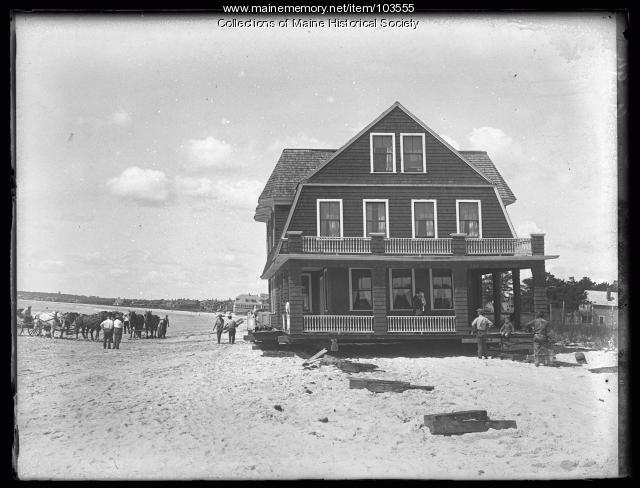
One such story involved the relocation of houses along the beach, a testament to the area’s resilience and adaptability. In 1890s and early 20th century storms and erosion along the beach continually threatened several beachfront homes. To preserve these structures, residents undertook the remarkable task of moving houses away from the encroaching shoreline. Photographs capture the sight of homes being transported across the sand, showcasing the community’s determination to protect their properties and heritage.
Although Pine Point was once dense with tall trees, development over the centuries, heavy logging in the 18th and 19th centuries, and changing weather patterns have led to further erosion posing some threats to the natural dunes and man-made structures. No homes are going to be dragged down the beaches, however, because enormous efforts to combat this issue have occurred. Dune systems now act as natural barriers against storm surges and coastal flooding.
In Pine Point, efforts have been made to rebuild and stabilize these dunes to protect homes and infrastructure. This includes planting native vegetation, such as American beach grass, which helps to hold the sand in place and promote dune growth. Additionally, the town has implemented regulations to control development and human activity in sensitive dune areas to prevent further degradation.
Preservation also occurs in the form of small parks, including Snowberry Park. In the 1930s, this area was home to an amusement park featuring a hand-carved carousel, which became a beloved attraction for both locals and visitors. The park was named after local proprietors Fred Snow and Perley Berry, who operated a restaurant and gift shop by the beach. While the amusement park no longer exists, its legacy endures in a small park still retaining the name.
These stories, among others, highlight Pine Point’s rich cultural tapestry and the enduring spirit of its residents. The area’s history is a blend of resilience, community effort, and a deep connection to its coastal environment, making Pine Point a unique and cherished part of Scarborough’s heritage. Though those massive old pines no longer remain, but with its long beach, delicious seafood, and welcoming vibe, Pine Point has developed into a truly unique place that honors its past and invites everyone to enjoy its present. So next time you’re in Scarborough, don’t just pass through Pine Point. Take a moment to soak in the history, savor the flavors, and enjoy the natural beauty of this unique spot.
Works Cited
Northeastern Lumber Manufacturers Association (NELMA), “The Tree That Sparked the Revolutionary War: Eastern White Pine’s Colonial History,” 2024.
Pine Point Association, homepage, accessed November 2024.
William S. Southgate, History of Scarborough from 1633 to 1783, Higginson Book Company, 1998.