By the School Building Advisory Committee
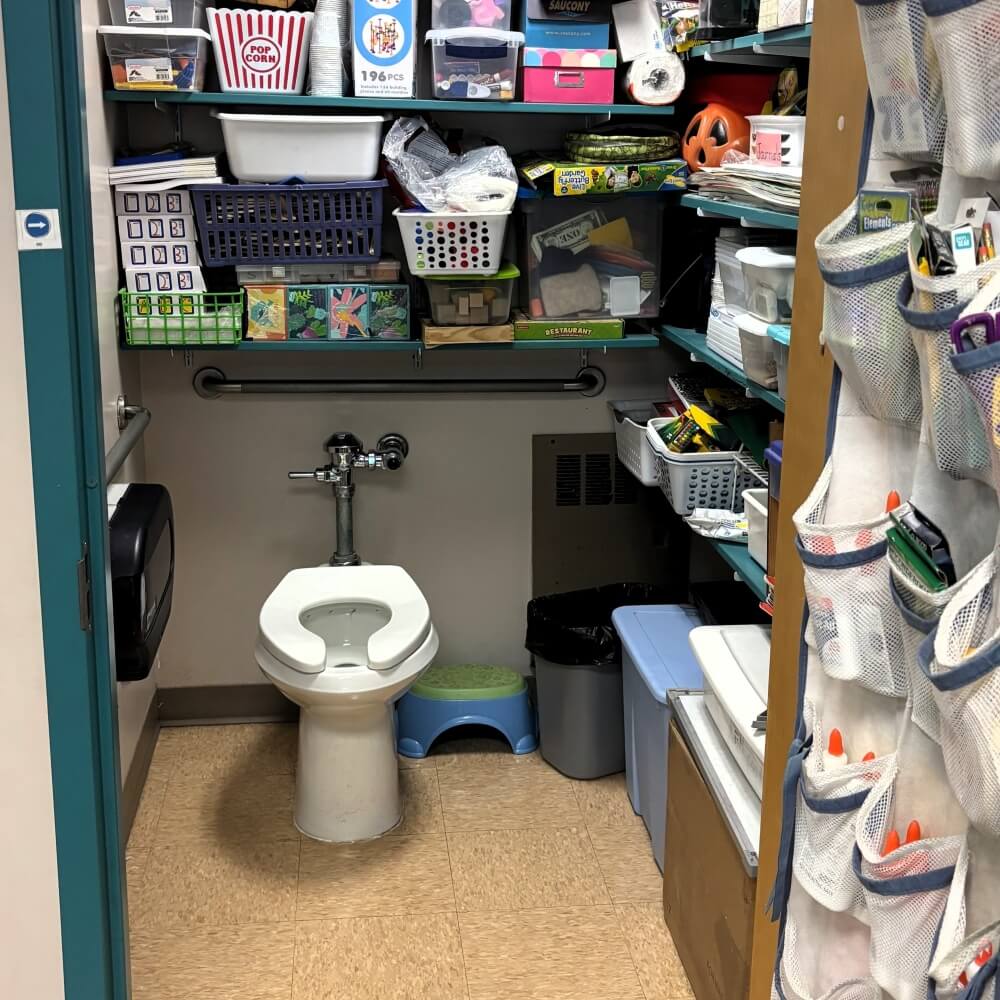
[Top photo: A bathroom at Eight Corners Primary School doubles as a supply closet.]
Step inside any of Scarborough’s three neighborhood K-2 schools and you’ll see the same challenges: crowded classrooms, aging buildings, and spaces designed for another era of education. These schools – Eight Corners, Blue Point, and Pleasant Hill – are stretched beyond capacity and need major updates.
At Scarborough Middle School, sixth graders trek between the main building and the row of portables that serves as their classrooms: rain, snow, or shine. At lunchtime, the cafeteria is so overcrowded that meals stretch across six lunch periods, with some students eating as early as 10:30 a.m.
The problems are real, and so is the commitment to solving them. The school project heading to voters in November 2025 is the result of nearly two years of study, discussion, and public input. It’s a plan shaped by the community, to meet the community’s needs.

If approved, the $129.85 million plan will invest in Scarborough’s K-8 schools for the long term. At the K-2 level, Blue Point and Pleasant Hill will see renovations and additions, and Eight Corners will be fully rebuilt. Wentworth Intermediate School (grades 3-5) will receive a small addition to accommodate future enrollment growth; and Scarborough Middle School (grades 6-8) will get a substantial addition to expand the cafeteria and accommodate the sixth grade. Construction is anticipated to finish by the start of the 2029-30 school year.
The referendum also includes a second question that gives voters the opportunity to approve $10 million to build a second story on the proposed Middle School addition. This larger addition would provide classrooms to accommodate increased enrollment expected in 2034-35.
How did we get here?
In November 2023, Scarborough voters rejected a $160 million plan for a consolidated school at Scarborough Downs. The referendum failed by a wide margin, with 62% voting ‘No’ and 36% voting ‘Yes’. Residents voiced concerns about the high price tag, the location, and a consolidated design that would have closed Scarborough’s three neighborhood primary schools.
This referendum failure revealed not only division, but opportunity. In response, the Town Council and the School Board committed to a more transparent, democratic approach, establishing the School Building Advisory Committee (SBAC). As School Board Chair Shannon Lindstrom noted, this was an intentional step toward inclusivity. “Forming the SBAC with community members marked an important step in the process. The SBAC was more than just a committee – it was a commitment to transparency, collaboration and meaningful engagement.”

The SBAC united parents, educators, taxpayers, and longtime residents to chart a new path. Beginning in early 2024, the committee gathered data, reviewed past proposals, and engaged the community through regular meetings, public forums, and town-wide surveys. The SBAC explored an extensive range of options, always balancing fiscal responsibility and community values.
The outcome of this work is more than a construction plan – it is a community-built solution. This new plan maintains the neighborhood K-2 schools while modernizing and expanding them for Scarborough’s future students. A full rebuild at Eight Corners Primary School offers the opportunity to create a school that can meet Scarborough’s needs for decades to come.

At the Middle School, the plan gives sixth graders a long-awaited home within the main building and creates a larger cafeteria sized for the full student body. The small addition at Wentworth efficiently expands the school to accommodate a growing student body.
For Blue Point Principal Kelly Mullen-Martin, who has attended SBAC meetings throughout the past 18 months, the process itself speaks to the strength of the solution. “The work has been tremendous. All the options that were vetted looked at what is best for the community and what is best for kids. Now we have a solution, and I’m all in. I think it’s really exciting – I hope the community embraces it.”


Why Now? The Challenges Facing Scarborough’s K-8 Schools
PRIMARY SCHOOLS (K-2; Blue Point, Pleasant Hill, Eight Corners)
- Overcrowding: These schools are operating over capacity, using 18 temporary modular classrooms. By 2028-29, Scarborough’s K-2 enrollment is expected to grow by 200 more students (based on children already born in Scarborough). There is no room to add additional modular classrooms on school properties.
- Competing Use of Space: Due to space limitations, many rooms are being used for multiple purposes — art/music, cafeteria/gym, special education/intervention programs. Transitioning between uses (moving tables, stacking chairs, clearing materials, etc.) cuts into instructional time and disrupts learning.
- Lack of Safety: Safety and security needs are very different today than when these schools were constructed. Improvements are needed to ensure all schools have secure entry vestibules, sufficient emergency access, lockdown zones, and other key infrastructure.
- Insufficient Professional Workspace: Schools lack teacher workrooms, space for the entire faculty to gather, and conference rooms for confidential conversations.
WENTWORTH SCHOOL (Grades 3-5)
- Enrollment Increase Expected: Wentworth is Scarborough’s newest school and is in excellent condition. However, enrollment is expected to grow by 200 by 2031-2032. A small addition will be required to handle this projected increase.
MIDDLE SCHOOL (Grades 6-8)
- Not Enough Classrooms: The middle school was undersized when it opened 20 years ago. Today, the sixth grade is housed in 12 detached portable classrooms, requiring students to travel to the main building multiple times each day. This raises safety concerns and creates particular challenges during bad weather.
- Undersized Cafeteria: This year, six lunch periods are needed (most schools have three to four), with the first starting as early as 10:30 a.m. Some students must have “split” lunch periods with 15 minutes of class in the middle, which interrupts learning.
- Art and Music Programming Displaced: Art instruction often takes place in regular classrooms, which aren’t suited for these activities and lack material storage. Music programs also lack space, sometimes using the cafeteria – further straining an area that is already too small.
FAQs
Why wasn’t a consolidated school solution selected?
A consolidated school was considered throughout the process. Here’s why the SBAC ultimately voted against it:
- Listening to Voters – Scarborough residents consistently expressed a preference for keeping the neighborhood schools.
- Cost – Building a consolidated school would cost about $17 million more than updating the neighborhood schools. The SBAC wanted to honor the $130 million limit favored by residents in a community survey.
- Keeping it Local – Some SBAC members and residents value minimizing the commutes of K-2 students, preserving a smaller community feel, and maintaining the character of each primary school.
How will this affect my property taxes?
Over the life of the bond, Question 1 would add $386 per year on average to the tax bill on a $600,000 home (Scarborough’s median home value). Question 2 would add $30 per year on average. Payments would be higher in the bond’s initial years and drop over time. The Scarborough Town Council Finance Committee is already discussing ways to minimize the peak tax impact. For more detailed tax estimates, scan the code below and go to the “FAQs”.
What justifies the project cost?
The SBAC worked to balance the needs of Scarborough’s students and staff with the cost to taxpayers. Inflation has sharply increased building expenses. Even so, the proposed $130 million bond is $30 million less than the 2023 bond. Most other cost-saving options would have been too impactful on students and staff, or would have increased costs over time. For example, skipping insulation in the K-2 schools might lower upfront costs, but would eventually result in higher heating bills.
Visit the SBAC website for more FAQs and information about the school building project.
Community Voices

Bill LaCasse – Parent of three children who attended Scarborough schools
“I have always been a strong supporter of the Scarborough schools but I voted ‘No’ on the 2023 school referendum. I felt that the 2023 proposal was too expensive and that it would diminish the beloved neighborhood school community. A big thanks to all the folks who worked so hard for almost two years on the School Building Advisory Committee. The new plan protects the neighborhood K-2 model, puts students first, and saves over $30 million when compared to the 2023 proposal.
“I am voting ‘YES’ on this November’s referendum. I am fortunate to have grown up in Maine attending public schools. My wife Lucy and I moved to Scarborough in 1981, and our three children all attended the wonderful Blue Point School. Lucy and I love the community-based model for younger children.
“Lucy and I are committed to supporting our schools even though we no longer have children in the system. As longtime Scarborough residents, we are both a strong ‘YES’ on the referendum.”

Fred Follansbee – Parent of two students, SBAC member
“Leading up to the last school vote, I was caught off guard by the significant price tag and a shift away from neighborhood schools. It warranted much more community discussion than what seemed to have taken place. As a former teacher, I felt that I had some professional expertise to offer.
“In the end, I have two main takeaways that lead me to support neighborhood schools: 1) Yes, the schools need renovation and the buildings need to accommodate a growing population. 2) The most important factor in a child’s education is good teaching. That problem is already solved for in our good schools.
“After this long process, I kept coming back to the original desire of the community to keep neighborhood schools. Above all, the most important factor in a child’s education is good teaching. Scarborough will carry out its mission of providing a good education to all students no matter what solution is put before voters. If they prefer the look and feel of neighborhood schools, that’s what we should provide for them!”

Kelly Mullen-Martin – Scarborough native, Blue Point Primary School Principal
“Education is so much more diverse today in terms of the services that kids need. That doesn’t just mean special education — but social-emotional support, academic support, kids that need to move their bodies. School is a more hands-on, dynamic place than it was back when I was a student at Pleasant Hill, sitting at my desk in a row. That’s the vision of school that people remember, but a lot has changed.
“Students now have a lot more autonomy for their own learning, which is a skill we really want them to develop. We want them to be creative thinkers.
“The spaces that our students are in now don’t fit what we are trying to provide them. We need to be infusing technology and giving them spaces — a calming space, as well as a space to collaborate and build and do hands-on learning. There’s no space for that. There’s no space for STEM. Then they get to Wentworth, and there’s a lot more opportunity, but really those opportunities should start earlier, in Kindergarten. That should flow K-12.”

Scott Milliken – Parent of two SMS students, SBAC1 member
“The proposed plan strikes an important balance. For those who envisioned a fully consolidated new school, this may not feel like the sweeping change they hoped for. But it is a pragmatic, effective solution that addresses urgent needs, respects Scarborough’s neighborhood school tradition, and does so at a fraction of the cost of the previous proposal. This is not just a compromise. It is a carefully considered plan that reflects Scarborough’s values, addresses our most pressing education challenges, and provides a fiscally responsible path forward.”

Laurie Alves – Wentworth teacher, parent of three Scarborough students
“I really love where I teach. I love this community (Scarborough): parents who genuinely want to be involved and love their kids. It sounds like a cliche but it’s true, we are a team. They want us to communicate and work together.
“From a parent perspective, one of the reasons we moved to Scarborough was the neighborhood schools. When my kids were going through their neighborhood school, I loved it. Because it really was true: They knew everyone, regardless of what grade they were in. They would see kids at the grocery store or beach and say ‘There’s Charlie! He’s in first grade, in Ms. So-and-so’s class.’ They were so connected to the community. Neighborhood schools are really powerful that way. It’s a sweet way for kids to start their education and to be in that close community. It’s important to have that connection.”

Charlie Peters – SBAC2 Chair, SBAC1 Vice Chair
“I voted ‘No’ on the 2023 school referendum because I felt uninformed about the details of the project. I didn’t fully understand the severity of the issues at our schools, and I didn’t understand why such a costly solution was needed, so I didn’t want to vote yes to something I was so uninformed about. So when the town announced the SBAC, I felt compelled to join so I could make a more informed vote on the next solution. I went into the SBAC with no biases on a solution – my goal was to learn about the issues, listen to people’s concerns, study the data and then back the best solution. My criteria for “best” was two-fold: 1) a long term solution that solved for the most pressing issues and 2) a solution that will pass at referendum.
“When I was elected to Chair SBAC2, I maintained these 2 criteria as my North-Star and led the committee with these goals in mind. Over the 18 months of working on the building committee, I became acutely aware of the overwhelming needs our schools were facing. We looked at dozens of options, including school makeup, size, design, construction methods, and non-traditional funding sources. We debated, we listened to the community, we compromised and ultimately we selected the option that met the criteria above. The selected option is not perfect, but it solves for the aging and overcrowded buildings, it’s fiscally responsible, and it best reflects the will of the community. I’m proud of the compromises the committee made to come up with a solution that will provide a fantastic long-term learning environment for our students, and that voters will support at the polls.”
Dave Heiberger – SBAC member
“Serving on the School Building Advisory Committee through both phases of this process has been one of the most thorough and collaborative efforts I have ever been part of. With nearly two decades in construction, including the last eight years in preconstruction and estimating, and experience helping design and estimate K12 school projects in Colorado and here in Maine, including the new school in Skowhegan, I joined this effort to help ensure decisions were grounded in real data and fiscal responsibility.
“The reality is this: construction costs rarely ever go down. I have spent nearly a decade estimating construction projects for large general contractors and I have seen what happens when clients and communities decide to wait for prices to drop. They do not. They rise, sometimes fast. A project delayed even a single year can come back 8 to 10 percent higher for the exact same scope of work. That is not opinion; that is market reality. Materials, labor, and financing costs continue to climb across the industry, and Scarborough is not immune to it. The cost of this proposal already includes projected market escalation built in specifically to carry the estimate through buyout and the start of construction. It is a realistic, responsible number. Delaying again would be a costly mistake, one that guarantees taxpayers will spend more and get less. Voting YES is the only fiscally responsible choice, backed by real data and real experience.
“From day one, the committee approached this project with diligence and accountability. Every option was explored, from renovations and additions to new construction and consolidation, and every cost was reviewed line by line to find savings without shortchanging students or the town. After almost two years of analysis, public input, and review, the numbers show this proposal is both realistic and responsible.
“This proposal was created by Scarborough residents from all walks of life who came together through healthy debate and compromise. It is not extravagant. It is smart, practical, and built for the future.
“Scarborough has done its homework. This plan represents a responsible investment in our students, our property values, and our community’s future. Please join your neighbors in voting YES. It is the right choice for our town.”