By Doug Hitchcox, Maine Audubon
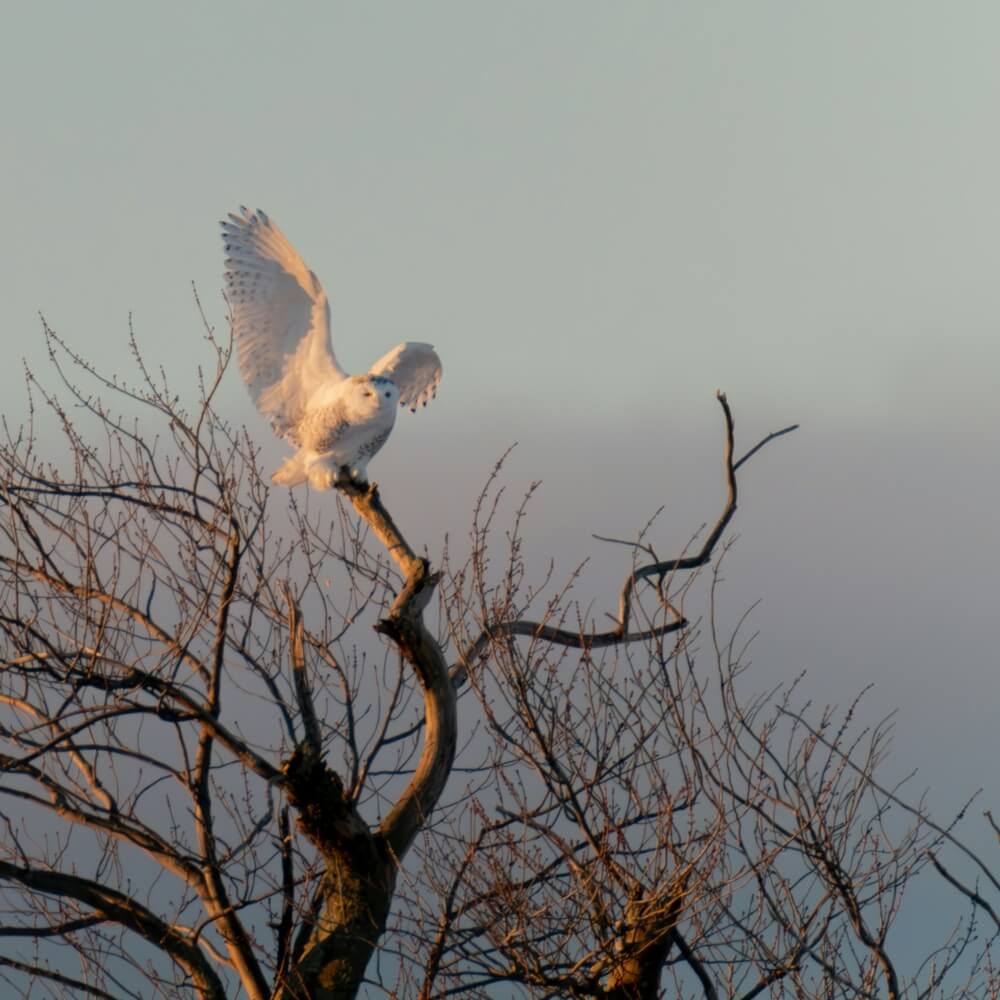
Snowy Owls are one of the most recognizable and charismatic species around. In Maine, we only see them as winter visitors and some years they can be completely absent. Most of the Snowy Owls we see in Maine are young birds likely looking for areas where there is less competition for resources. Adults nesting throughout the summer in Canada will lay more or fewer eggs based on the local abundance of food, primarily made up of lemmings and voles. In years with high reproductive success, you could start with a pair of Snowy Owls in a territory, see them fledge up to 8 chicks (clutch sizes range from 3 to 11 eggs), and then go from 2 to 10 birds competing for food in the same area. The inexperienced youth are often pushed off their parents’ or other adults’ territories, and so will journey south looking for food.
Lemming populations are cyclical, and when they are in high abundance Snowy Owls will have more chicks. Male Snowy Owls make food deliveries to females on the nest, and the amount of food he brings correlates to how many eggs the female lays. Thus, Snowy Owl reproductive success matches the lemming cycle. In some years, we see huge numbers of Snowy Owls come south. This is known as an irruption, when a species that typically migrates from point A (breeding grounds) to point B (wintering grounds), can’t find enough resources (typically food) in one place, and temporarily moves to point C (in this case, Maine). Most birds resume their point A-to-B movement after an irruptive year.
In winters when we see Snowy Owls in Scarborough, it tends to be from December through March. As exciting as it is, I worry a bit about the attention that these owls attract. I’ve heard that people are naturally attracted to owls because of their forward-facing eyes. This appeal, plus the way owls can seem very approachable, leads to excessive harassment.
So far this winter, there have been at least three Snowy Owls sighted near the Scarborough Marsh. From the photos we’ve seen, all appear to be young (born last summer) based on markings on the birds’ wings. The marsh has many rodents like those the owls would hunt in their summer range, but also ducks. On January 2, onlookers were treated to an apparent female Snowy Owl catching a Long-tailed Duck near the beach!
Snowys seem approachable because they often sit still even as people approach, but this is because their main defense is camouflage. They probably think that if they are still they won’t be harmed. Unfortunately, many people, even those equipped with long telephoto lenses, can’t resist approaching closer than they should and often flush the resting birds. For birds that are trying to conserve energy, repeated flushings can become deadly if the bird is forced to keep wasting energy to get away from gawkers.
If you have an opportunity to see one of these amazing birds, please be respectful. Only get as close as you need to. You may actually have a better chance of getting to see one hunt if you are far enough away not to disturb any prey. There are no set “rules” on how close is too close, but my typical recommendation is that if the bird looks at you, you are too close and should move back. Ideally, you should be able to watch the bird without changing its behavior, and that includes getting its attention.
Doug Hitchcox is a Staff Naturalist at Maine Audubon. Photo by Hunter Masters (cropped).
Scarborough Marsh Audubon Center
92 Pine Point Road | 207-883-5100