By Jim Hartley
In the past decade and a half of selling the enigmatic Homarus americanus, I’ve learned a lot about this magnificent crustacean, but reading Trevor Corson’s The Secret Life of Lobsters ten years ago took me to a new plane of appreciation. I expected light summer reading…with more of the hokey “did you know lobsters were once fed to prisoners?” material. Instead, I learned that the animal I sell every day is stranger than I’d ever given it credit for…and a lesson I didn’t expect to bring home to the shop.
Corson spent two years as a sternman on a boat out of Little Cranberry Island. The book follows three threads that turn out to be one story: the lobster, the lobstermen who’ve fished these waters for generations, and the scientists who’ve spent fifteen years figuring out why the lobster population behaves the way it does.
Here are five facts that still surprise customers when I share them at the counter:
- Lobsters smell through their feet, chew with their stomachs, and pee out their face.
- Molting is basically resurrection. Every time a lobster grows, it sheds its entire shell, leaving it super soft for days. Its new shell is about 1/3 bigger than the lobster at the time, leaving room to grow. The extra room is filled with water. I’d eaten soft-shells for years without fully understanding why they’re gentler and sweeter; now I explain the “why” instead of just the price.
- Their eyes work nothing like ours. Instead of bending light through a lens, a lobster’s eyes are made of thousands of tiny mirrored squares that reflect light onto the retina, rather than refract – a design so unusual it’s inspired telescope engineers studying deep-space X-rays.
- The claws aren’t identical for a reason. One is a heavier “crusher” claw (slow twitch muscle), the other a sharper “pincher” (fast twitch). Which claw is used de-pends on the task. (Getting pinched by either hurts in its own maddening way.)
- Baby lobsters are jet-propelled. Scientists call the tiny post-larval stage “super-lobsters” – for a brief time after hatching, they rocket through open water at surprising speed, claws out like tiny superheroes, before settling to the bottom for good.
What stuck with me most was Corson ‘s insistence that fishermen’s hands-on knowledge and scientists’ data both mattered, and that the real story only came into focus once the two stopped talking past each other. I apply this methodology at our shop. When a customer asks why soft-shells cost less or why prices fluctuate within a season, I don’t just quote the number anymore, I tell them what’s actually happening, along with some fun facts. Understanding the biology doesn’t just make me a better storyteller, it makes a simple business transaction an empathetic experience…more human. Turns out the best lesson I learned from a book about lobsters wasn’t about lobsters at all.
Enjoy lobster, and eat slow.

Jim Hartley is a Scarborough resident and owner of Pine Tree Seafood and Dunstan Smokehouse.
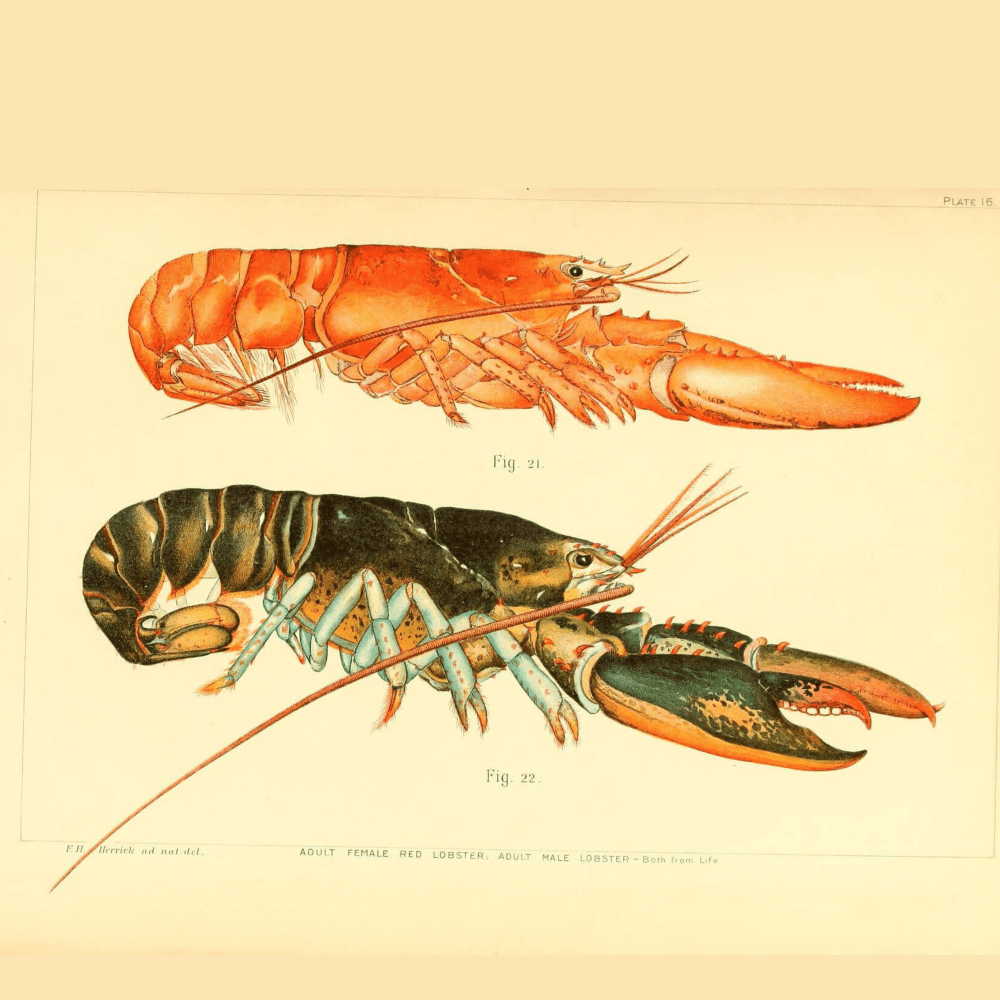
Top photo: Illustration by Francis Hobart Herrick, 1895